

Types of Air Ducts Explained
Rigid, flexible, fiberboard, fabric, and PVC, what’s actually running through your attic, and why it matters when it’s time for a cleaning.
Quick answer: There are five main types of residential and commercial air ducts: sheet metal (rigid), flexible duct, fiberboard, fabric, and PVC. Most Tampa Bay homes use either sheet metal or flexible duct, and the material determines how the ductwork should be cleaned and how long it typically lasts.
The 5 Types of Ductwork at a Glance
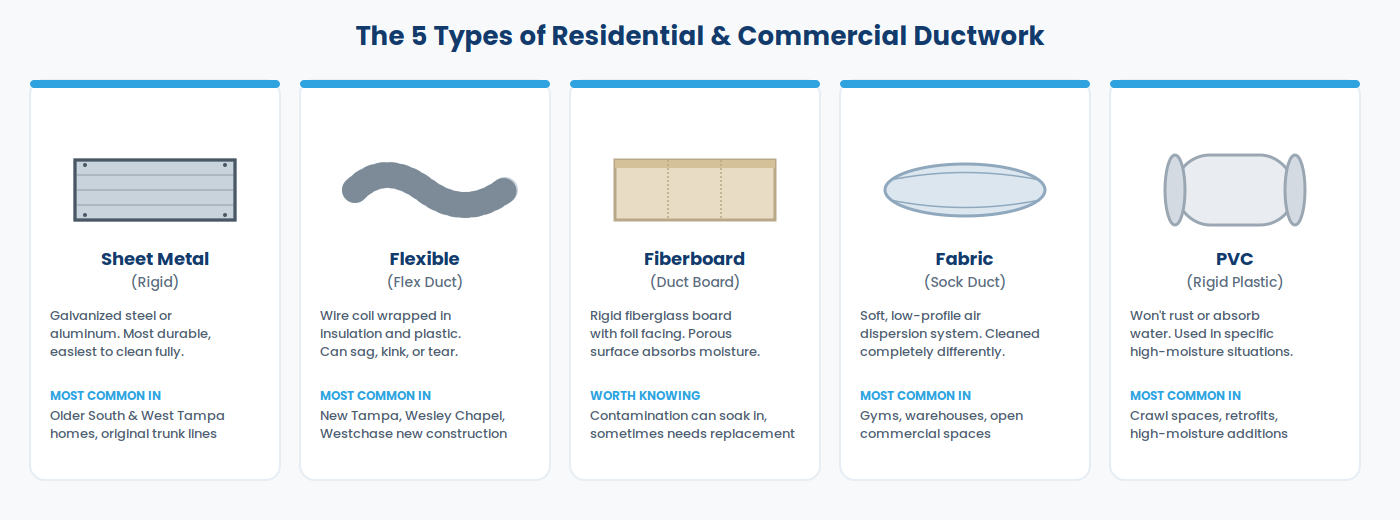
Each material behaves differently under Tampa’s humidity, and that changes how we approach cleaning and maintenance.
Most homeowners never think about what kind of ductwork is actually running through their attic until something goes wrong, or until a technician like me shows up and starts asking questions about it. The material your ducts are made from changes almost everything: how they’re cleaned, how long they last, and how much trouble Tampa’s humidity gives them over time. Here’s what’s actually up there, and why it matters for your specific home.
The 5 Main Types of Residential & Commercial Ductwork
Sheet Metal (Rigid) Ducts
Galvanized steel or aluminum formed into rectangular or round sections. This is the most durable material out there and the easiest to clean thoroughly, since a technician can run a brush or negative-air tool through it without worrying about damaging the interior surface. In older South Tampa and West Tampa homes, you’ll often find original metal trunk lines from decades ago, sometimes patched together with newer flexible sections during a retrofit.
What this means for you: Metal ducts hold up well to cleaning, but in coastal areas they’re more prone to corrosion over time from salt air. See our guide on salt air and coastal duct maintenance.
Most durable · Easiest to clean fullyFlexible (Flex) Ducts
A coil of wire wrapped in insulation and a plastic vapor barrier. It’s cheaper and faster to install than metal, which is why it’s everywhere in newer construction throughout New Tampa, Wesley Chapel, and Westchase. The tradeoff is that flex duct is more delicate, it can sag, kink, or develop small tears over time, all of which restrict airflow and create spots where dust settles and doesn’t move.
What this means for you: Flex duct needs a gentler cleaning approach than metal. An aggressive brush can damage the interior liner, so we adjust technique based on what we find during inspection.
Common in new construction · Needs gentler handlingFiberboard Ducts
Less common today, but still found in some older Tampa Bay homes. Fiberboard duct is rigid fiberglass board with a foil facing, popular for a stretch because it’s naturally insulated. The problem is the interior surface is porous, meaning dust and moisture can actually get absorbed into the material itself rather than sitting on the surface where it can be cleaned off.
What this means for you: Fiberboard ductwork showing mold or heavy contamination sometimes can’t be cleaned back to a safe condition, replacement is the more honest answer in that case. See our duct replacement page.
Porous surface · Sometimes needs replacementFabric (Sock) Ducts
You’ll mostly see fabric duct in commercial settings, gyms, warehouses, big open spaces where a soft, low-profile duct system makes sense. It’s not common in residential Tampa homes, but if you’ve got a home gym or converted commercial space, it’s worth knowing this exists and that it’s cleaned completely differently from rigid ductwork.
Commercial spaces · Different cleaning methodPVC and Rigid Plastic Ducts
Occasionally used in specific situations, crawl spaces with high moisture, for example, since PVC won’t rust or absorb water the way metal or fiberboard can. It’s not the norm for whole-home duct systems, but it shows up in retrofits and additions more than people realize.
Moisture-resistant · Used in retrofits
Why Duct Material Matters for Cleaning
Does the type of ductwork affect how you clean it? Yes, significantly. Metal ducts can handle a thorough brush-and-vacuum approach. Flex duct needs a gentler touch to avoid damaging the liner. Fiberboard sometimes can’t be fully restored if contamination has soaked into the material. We identify duct material during every inspection before we start cleaning, it’s part of our 8-step process.
Can different duct materials be mixed in one house? Very common, especially in older Tampa homes that have been retrofitted over the decades. You might have original metal trunk lines with newer flex duct branches added during a later renovation. We check the whole system, not just one section.

How We Identify Your Duct Type
Every job starts the same way: a full attic and system inspection before we quote or touch anything. We check for material type, connection quality, sagging or damaged sections, and signs of past retrofits. This is standard on every job, whether you’re in South Tampa, New Tampa, or anywhere else in the Tampa Bay area.
Once we know what we’re working with, we tell you honestly, in writing, what it needs and what it costs. See real numbers on our Pricing page.
Quick Answers
How do I know what kind of ductwork I have?
Most homeowners don’t know, and that’s fine, it’s exactly what we check during a free inspection before quoting any work.
Is metal duct always better than flex duct?
Not necessarily “better,” just different. Metal is more durable and easier to clean thoroughly. Flex is cheaper to install and works fine when it’s properly supported and not damaged. Both need regular maintenance either way.
Should I replace flex duct with metal?
Only if there’s a specific reason, damage, chronic sagging, or repeated contamination. If your flex duct is intact and functioning, cleaning is usually all it needs. See our Pricing page for what a standard cleaning runs.
Can I check my duct type myself before calling anyone?
Yes, a flashlight look in your attic can usually tell you if you’re looking at metal or flex duct. Fiberboard and fabric are less common and a bit harder to identify without experience, that’s where a professional inspection helps.
Related Guides & Services
Not Sure What’s in Your Ductwork?
We’ll identify your duct type and tell you honestly what it needs, in writing, before any work begins.
📞 Call (656) 246-9249